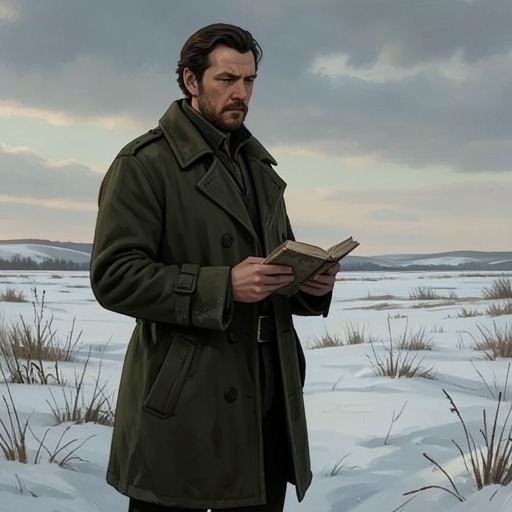
Labrador
Last and First MenLabrador becomes the setting of a long divergence in human history: a storm-driven shipwreck leaves a tiny band stranded there, and the descendants of that band eventually spread across continents while losing nearly every mark of their former culture. In the book’s account, the place is not merely a destination for survivors but the starting point of a human lineage transformed by climate, isolation, and time.
The shipwrecked settlement
The people who left the Siberian settlement were driven west and southwest, past an Iceland reduced to a cluster of volcanoes, and on toward Labrador. Fantastic storms and oceanic convulsions took nearly half their number. By the time the ship could no longer be worked and was wrecked on a rocky coast, only the carpenter’s mate, two women, and a pair of monkeys managed to reach shore. Those who remained in Siberia heard nothing more from the wanderers and eventually assumed they had perished.
The coast offered a climate far more sultry than Siberia, but, like their former home, Labrador had uplands rich in vegetation. At first the survivors struggled to find food. They eventually adapted to berries and roots, establishing a precarious life in a landscape that was at once fertile and markedly unlike the place they had left.
Climate and human decline
The effects of Labrador’s climate unfolded over generations. The heat undermined the settlers’ mentality, and their descendants descended into what the narrative calls abject savagery, retaining humanity only through ancestry. This decline contrasts with the Siberian settlement’s deliberate effort to preserve culture: Labrador’s people had no comparable cultural inheritance or collective project to sustain them.
Across the Second Dark Age, the two settlements followed sharply different courses. The Labrador settlement, weakened by the more oppressive climate and lacking the Siberian will to preserve human culture, sank into animality. Yet it did not disappear: its descendants ultimately populated the whole West in swarming tribes. The site of the wreck thus marks the beginning of a lineage whose spread continued even as its inherited culture eroded.
Descendants encountered in Africa
Millions of years after the shipwreck, an expedition of the Second Men crossed the gigantic Hindu Kush to explore Africa and encountered the subhuman descendants of the Siberia-to-Labrador voyagers. By then, those descendants had spread south through America and crossed the new Atlantic Isthmus into Africa. Their history connects an isolated Labrador shore to a much broader movement across continents and to a later encounter between distinct human forms.
The creatures the expedition found were dwarfed beside the Second Men, often using their arms to aid their bent-legged movement, and had flat heads and long snouts. The narrative describes them as more baboon-like than human. They had developed a complex caste system based on smell: odors associated with particular diseases were treated as sacred, and the more repulsive the scent, the greater its bearer’s status. Although the diseases debilitated and eventually killed their carriers, they also stimulated reproduction; healthy members cared for the afflicted and could even welcome infection. This social order, and the immense fertility it accompanied, helps explain how the descendants of the Labrador survivors spread so widely despite disease and diminished intelligence.
A place at the hinge of human history
Labrador’s significance lies in the contrast between settlement and transformation. It initially sustains a handful of shipwreck survivors through adaptation to berries and roots, but the same history there becomes a protracted loss of culture and mental capacity. The resulting descendants are not confined to the coast: their migration across the West and onward into Africa makes Labrador an origin point in the book’s account of later human diversity.
The narrative links environmental pressure to change across a scale that exceeds any single generation or community. Labrador is where a failed voyage becomes a lasting separation between human populations, and where the distinction between cultural inheritance and mere ancestry acquires concrete form.